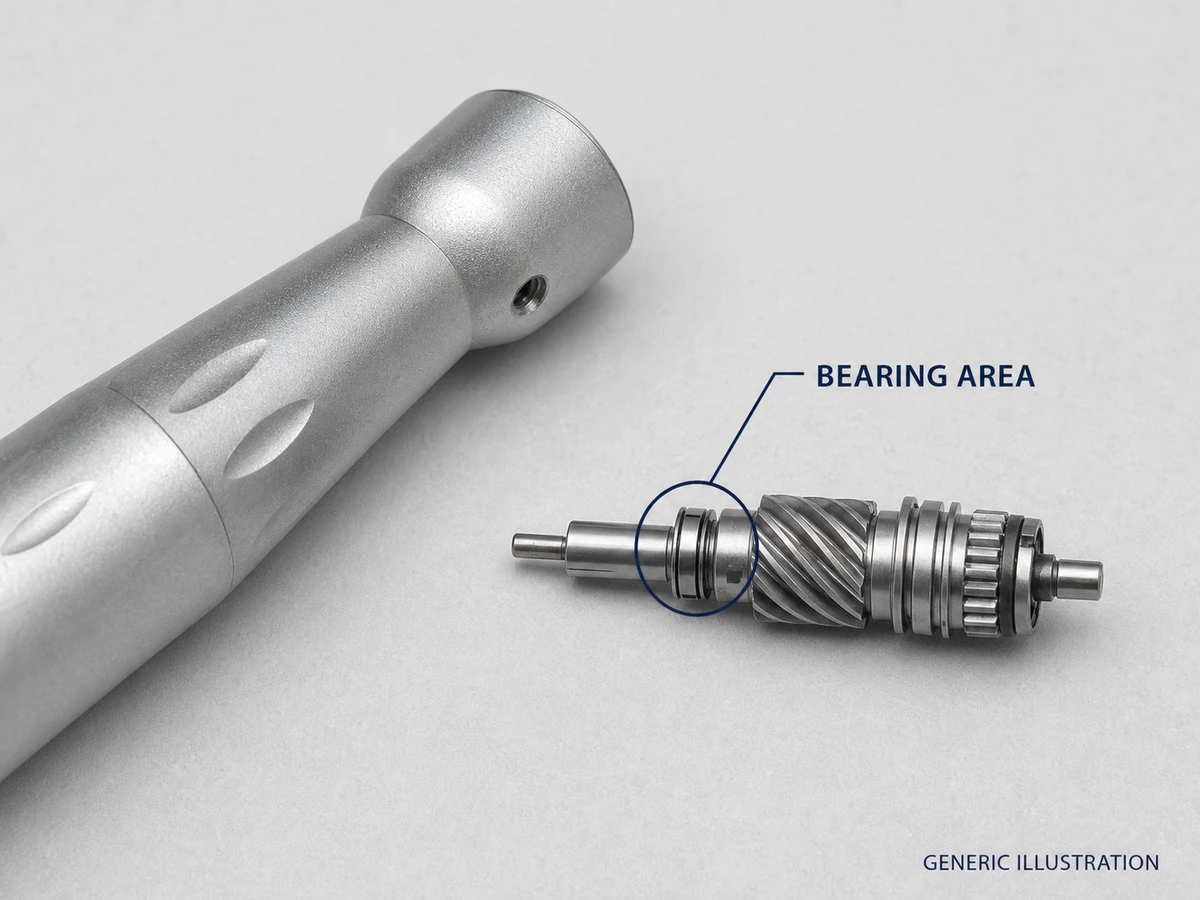
A contra-angle head bearing costs you a few dollars. Send that same head out for bearing replacement and the bench bill runs about $159; replace the whole head-gear cartridge and you are looking at roughly $455. For a repair shop turning over dozens of low-speed handpieces a month, that gap is the entire margin. This page is the complete aftermarket catalog of low-speed and contra-angle dental handpiece bearings we stock: 35 verified models with real ID × OD × W dimensions, ball materials, shield codes, and broad brand fitment across KaVo, NSK, W&H, Sirona and Bien-Air. Browse the full size chart below, or jump straight to brand fitment. Every contra angle handpiece bearing here sells for somewhere between $2.20 and $35.95 — the math of rebuilding in-house writes itself.

Aftermarket replacement part. Independently manufactured — not supplied by or affiliated with the handpiece manufacturer.

Low-Speed Handpiece Bearings: Key Specs at a Glance

  • Low-speed handpieces run 20,000–40,000 RPM under high torque; you cannot drop in an SR144 high-speed turbine bearing built for 400,000 RPM.
  • 35 models span micro-bore 1.5 mm contra-angle heads up to 10 mm lab micromotor rotors — and most low-speed sets need 2–3 different sizes to rebuild.
  • 440C stainless handles standard low-speed torque best; reserve silicon nitride ceramic for 1:5 speed-increasing contra-angles.
  • ZZ shields and 2RS seals keep operatory debris out of the raceway — the usual reason a low-speed bearing fails before its time.
  • Every model is available as singles, multipacks and wholesale quantities, with tiered repair-shop pricing and same-spec replacement for worn OEM bearings.

Low-Speed vs High-Speed Turbine Bearings — Why You Can’t Swap Them

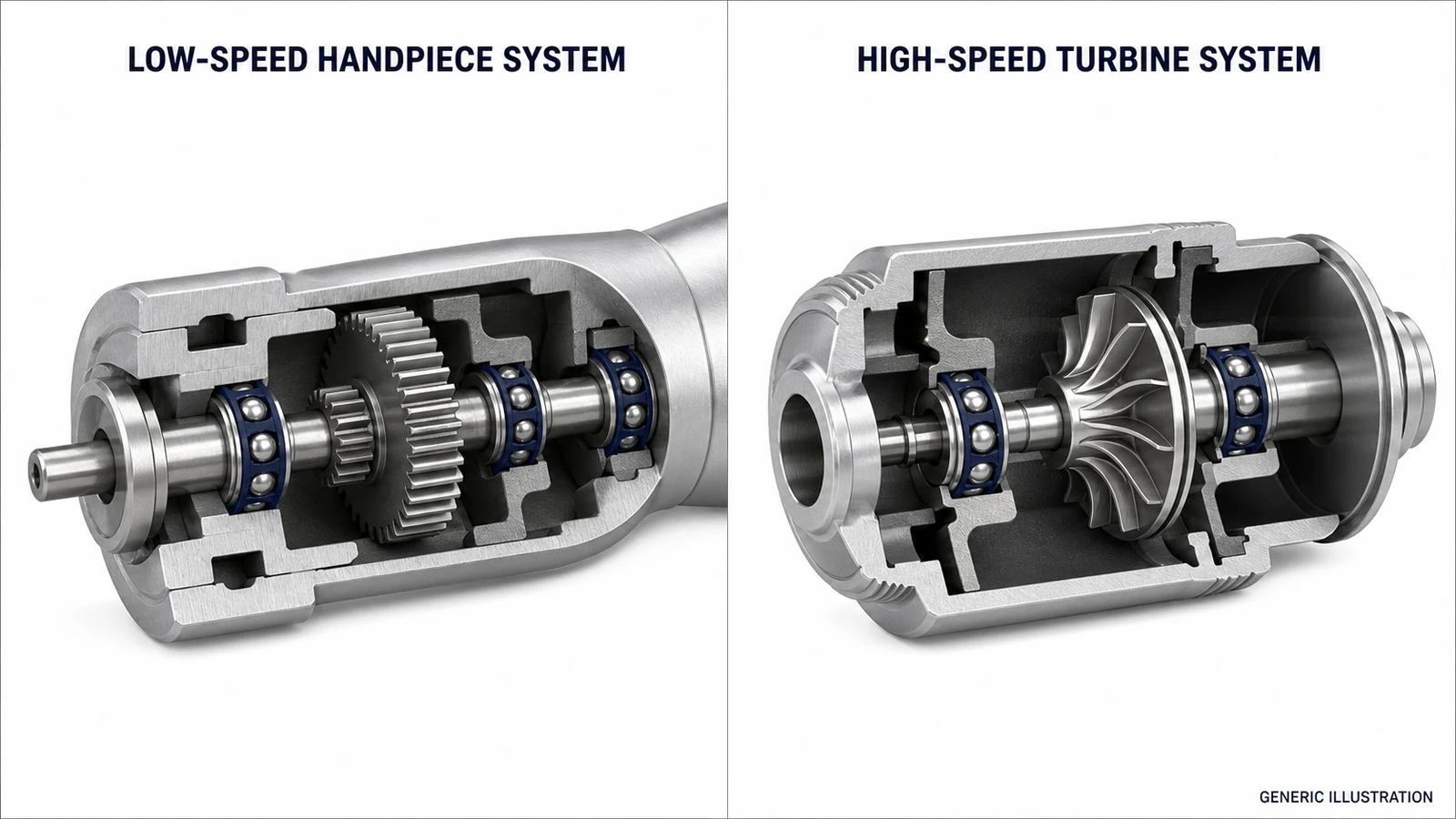
The two bearing populations in a dental operatory share almost nothing mechanically. A high-speed turbine spins an angular-contact high-speed turbine bearing past 400,000 RPM with almost no axial load — the chuck just has to stay balanced. A low-speed handpiece runs a deep-groove bearing at 20,000–40,000 RPM while the head is dragging a latch-type bur through enamel, generating real torque and axial thrust the whole time. The speed boundary itself is set by ISO 14457, the international standard for dental handpieces and motors.

That difference decides the bearing geometry. An angular-contact turbine bearing has a split inner race and a cage tuned for speed, not load. Put it in a contra-angle head and the first time the bur bites, the raceway dents and the head screams. A low-speed bearing is a deep-groove design with a heavier cage (polyimide or Torlon) built to spread torque across the balls and survive the impact of a catching bur.

The envelope can look identical — a 3.175 × 6.35 × 2.78 mm SR144ZZ sits right next to the low-speed intermediate-gear bearings in the chart below — but the internal construction is not interchangeable. Fit the right speed class and your rebuild lasts; fit the turbine part and you are back at the press in a week.

Rule of thumb: if the handpiece has a turbine whine and a push-button chuck, it is high-speed. If it has a contra-angle or straight nosecone with a latch bur, it is low-speed — and the SR144 high-speed turbine bearings are the wrong box to pull from.

Complete Low-Speed & Contra-Angle Bearing Size Chart (35 Models)

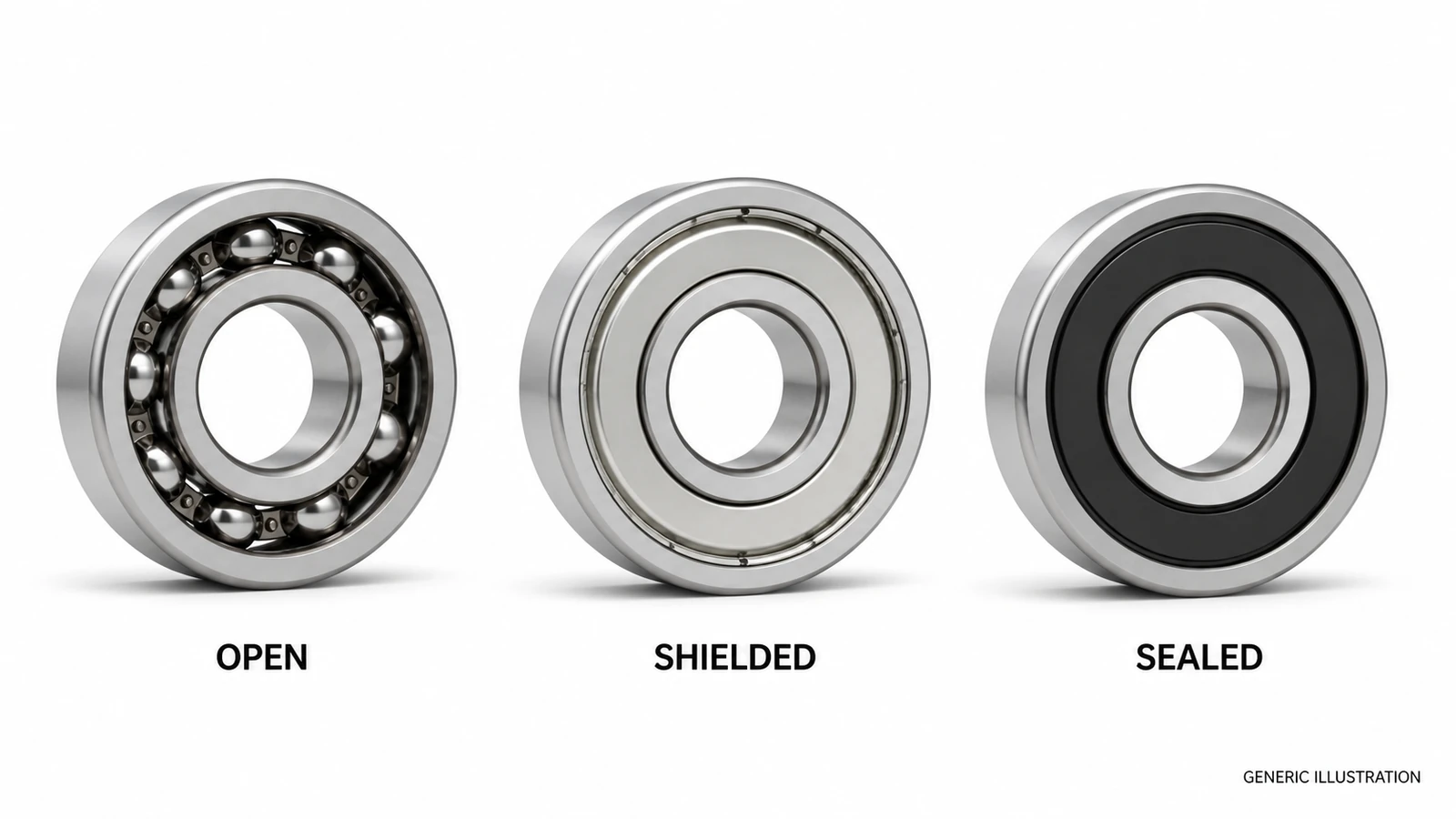
Below is the full catalog: 35 real models with the exact dimensions we stock — sizes are ID × OD × W in millimetres, and shield codes follow the model suffix (ZZ = metal shield, 2RS = rubber seal, open = no closure); where a suffix does not define the closure we confirm it per model.

Master chart — all 35 models

Model ID×OD×W (mm) Ball Material Shield Precision Typical Application Fits Brands
S681 1×3×1 440C SS open ABEC-5 / P5 Contra-angle intermediate gear / index pinion All major brands
S681X 1.5×4×2 440C SS open ABEC-5 / P5 Contra-angle micro gear All major brands
S682 2×5×1.5 440C SS open P4 / ABEC-7 Precision contra-angle gear All major brands
SMR52 2×5×2 440C SS open ABEC-5 / P5 Contra-angle head gear All major brands
S692k 2×6×2.3 440C SS — (per model) ABEC-5 / P5 Contra-angle gear / E-type nosecone All major brands
S692z 2×6×2.5 440C SS ZZ ABEC-5 / P5 Contra-angle gear All major brands
S69222 2×6×3 440C SS 2RS ISO-grade (P5+) Contra-angle gear, sealed All major brands
SMR63 3×6×2 440C SS open ABEC-5 / P5 Contra-angle head bearing All major brands
SMR63z 3×6×2 440C SS ZZ ABEC-5 / P5 Contra-angle head bearing, shielded All major brands
S683 3×7×3 440C SS open ABEC-5 / P5 Contra-angle head / gear All major brands
S6832 3×7×2 440C SS 2RS ABEC-5 / P5 Contra-angle gear, sealed All major brands
SMR83k 3×8×2 440C SS — (per model) ABEC-5 / P5 Contra-angle head bearing All major brands
SMR832Z 3×8×3 440C SS ZZ ISO-grade (P5+) Contra-angle head, shielded All major brands
S69322 3×8×4 440C SS 2RS ISO-grade (P5+) Contra-angle gear, sealed All major brands
S62322 3×10×4 440C SS 2RS ABEC-5 / P5 Contra-angle output gear All major brands
SR144ZZ 3.175×6.35×2.78 440C SS ZZ ABEC-5 / P5 Contra-angle intermediate gear (imperial) All major brands
SMR74 4×7×2 440C SS open ABEC-5 / P5 Straight head / nosecone All major brands
SMR84 4×8×2 440C SS open ABEC-5 / P5 Straight head shaft All major brands
SMR8AZZ 4×8×3 440C SS ZZ ABEC-5 / P5 Straight head, shielded All major brands
S684zz 4×9×4 440C SS ZZ ABEC-5 / P5 Air-motor pinion All major brands
DS-4H 4×10×4 440C SS — (per model) ABEC-5 / P5 Air-motor / specialty All major brands
S604zz 4×12×4 440C SS ZZ ABEC-5 / P5 Air-motor pinion All major brands
SMR8S 5×8×2 440C SS — (per model) ABEC-5 / P5 Straight head / air-motor All major brands
S695 5×13×4 440C SS open ABEC-5 / P5 Air-motor rotor All major brands
S68622 6×13×5 440C SS open ABEC-5 / P5 Air-motor rotor / straight head All major brands
S6252L 5×16×5 (typ.) 440C SS 2RS ISO-grade (P5+) Lab micromotor / air motor All major brands
S687 7×14×3.5 440C SS open ISO-grade (P5+) Lab micromotor rotor All major brands
S688 8×16×4 440C SS open ABEC-5 / P5 Lab micromotor / air motor All major brands
S6700 10×15×3 440C SS open ABEC-5 / P5 Lab micromotor rotor All major brands
DS-2H 2.38×4.76×2.38 440C SS — (per model) ABEC-5 / P5 Contra-angle push-gear (imperial) All major brands
DS-3E 3×7×3 440C SS — (per model) ABEC-5 / P5 Contra-angle head (specialty) All major brands
DS-3N 3.96×7.938×2.78 440C SS — (per model) ABEC-5 / P5 Contra-angle head (imperial) All major brands
DS-2J per spec sheet 440C SS — (per model) ABEC-5 / P5 Specialty contra-angle fitment All major brands
DS-3M per spec sheet 440C SS — (per model) ABEC-5 / P5 Specialty contra-angle fitment All major brands
DS-5J per spec sheet 440C SS — (per model) ABEC-5 / P5 Specialty air-motor fitment All major brands

You usually need two or three sizes to rebuild one low-speed set — a contra-angle head alone typically takes a micro-bore gear bearing plus a head bearing, and an air motor adds a larger rotor bearing. Our bearing kits bundle the common combinations so you are not caught short mid-rebuild.

Notes: “ISO-grade” marks models supplied to an ISO tolerance specification (P5 or better). Si₃N₄ ceramic balls are available on request for the 1:5 speed-increasing contra-angle sizes. DS-series and the S6252L dimension are released per the engineering spec sheet on order confirmation — use our free bearing identification service and we confirm the exact envelope.

Micro-Bore 1.5–3 mm — Contra-Angle Heads & Intermediate Gears

These are the bearings that live inside the contra-angle head: the small gear bearings that transfer motor torque to the bur, plus the head bearing itself. A single contra-angle head usually takes two or three of these — a micro gear bearing and a head bearing, sometimes a push-gear as well.

Model Size (mm) Shield Application Fits
S681 1×3×1 open Intermediate gear All major brands
S681X 1.5×4×2 open Micro gear All major brands
S682 2×5×1.5 open Precision gear (P4) All major brands
SMR52 2×5×2 open Head gear All major brands
S692k 2×6×2.3 per model Gear / nosecone All major brands
S692z 2×6×2.5 ZZ Head gear All major brands
S69222 2×6×3 2RS Sealed gear All major brands
SMR63 3×6×2 open Head bearing All major brands
SMR63z 3×6×2 ZZ Shielded head All major brands
S683 3×7×3 open Head / gear All major brands
S6832 3×7×2 2RS Sealed gear All major brands
SMR83k 3×8×2 per model Head bearing All major brands
SMR832Z 3×8×3 ZZ Shielded head All major brands
S69322 3×8×4 2RS Sealed gear All major brands
S62322 3×10×4 2RS Output gear All major brands
SR144ZZ 3.175×6.35×2.78 ZZ Intermediate gear (imperial) All major brands

Mid-Bore 4–6 mm — Head Shafts, Straight Nosecones & Air-Motor Pinions

This band covers the straight handpiece head shaft, the E-type nosecone that couples to the air motor, and the smaller air-motor pinion bearings. They take more torque than the micro-bore parts, so the cages are heavier.

Model Size (mm) Shield Application Fits
SMR74 4×7×2 open Straight head All major brands
SMR84 4×8×2 open Head shaft All major brands
SMR8AZZ 4×8×3 ZZ Shielded head All major brands
S684zz 4×9×4 ZZ Air-motor pinion All major brands
DS-4H 4×10×4 per model Air-motor / specialty All major brands
S604zz 4×12×4 ZZ Air-motor pinion All major brands
SMR8S 5×8×2 per model Straight head / motor All major brands
S695 5×13×4 open Air-motor rotor All major brands
S68622 6×13×5 open Air-motor rotor All major brands
S6252L 5×16×5 (typ.) 2RS Lab micromotor / motor All major brands

Large-Bore 7–10 mm — Air Motors & Lab Micromotors

The biggest bearings in the low-speed family sit in the air-motor rotor or the lab micromotor. These carry the full motor output and run warm, so cage temperature rating matters more than at the head.

Model Size (mm) Shield Application Fits
S687 7×14×3.5 open Micromotor rotor All major brands
S688 8×16×4 open Air motor / micromotor All major brands
S6700 10×15×3 open Micromotor rotor All major brands

DS-Series Specialty — Imperial & Custom Envelopes

The DS codes are custom envelopes for specific contra-angle heads and air motors, including imperial sizes that do not map to a standard metric miniature. Dimensions for DS-2J, DS-3M and DS-5J are released per spec sheet on order.

Model Size (mm) Shield Application Fits
DS-2H 2.38×4.76×2.38 per model Contra-angle push-gear (imperial) All major brands
DS-3E 3×7×3 per model Contra-angle head (specialty) All major brands
DS-3N 3.96×7.938×2.78 per model Contra-angle head (imperial) All major brands
DS-2J per spec per model Specialty contra-angle All major brands
DS-3M per spec per model Specialty contra-angle All major brands
DS-5J per spec per model Specialty air-motor All major brands

Find Your Contra Angle Handpiece Bearing by Brand

Brand rarely changes the bearing envelope — it changes the part number printed on the box. The 35 models above cover the contra-angle and low-speed fitments for every major manufacturer, so start from the size you measured and confirm against the brand page.

KaVo. KaVo’s INTRAmatic-pattern low-speed heads (ZW-K1 through ZW-K5) and air motors use the standard micro-bore gear and head bearings in the chart. Our KaVo contra-angle bearings page lists the matching sizes for each part number.

NSK. NSK’s contra-angle and straight low-speed lineup (White, Ti-Max) draws from the 1.5–6 mm band. See the NSK-compatible low-speed bearings page for the size match.

W&H. W&H runs the WA-99, WA-56 and WS-75 contra-angles on the same gear-bearing geometry as the rest of the field. The W&H contra-angle bearings (WA-99, WA-56, WS-75) page lists the matching sizes.

Sirona. Sirona’s T1 / T2 low-speed and contra-angle heads use the mid-bore head-shaft and micro-bore gear bearings. Our Sirona T1 / T2 contra-angle bearings page covers the full set.

Bien-Air. Bien-Air’s 1:5 speed-increasing contra-angles are the one place ceramic earns its keep (more below). The Bien-Air 1:5 contra-angle bearings page lists the micro-bore sizes and the ceramic option.

Traus and Saeshin build the air motors and lab micromotors that run the 6×13×5, 8×16×4 and 10×15×3 mm rotor bearings — the same large-bore models in the chart fit them. Prefer to start from the handpiece itself? Search by handpiece model.

How to Identify a Low-Speed Bearing When the Markings Are Gone

Bearings arrive at the bench with the laser etch worn flat and the shield packed with paste. You do not need the number — you need three measurements.

  1. **Measure with digital calipers.** Take the inner diameter (ID, the shaft the bearing rides on), the outer diameter (OD, the seat in the head), and the width (W) in millimetres. Write all three down before the old bearing goes in the solvent. Then match the triple against the master chart above — most low-speed sizes are unique enough that ID × OD × W alone identifies the model. Cross-check against the [full dental bearing size chart](/dental-bearing-size-chart/) if the number looks familiar.
  2. **Decode what is left.** If any marking survives, the letters tell you the closure: a trailing **ZZ** means metal shields, **2RS** means rubber seals, and no suffix means open. A **P4** or **ABEC-7** stamp means it was a precision-grade part — replace it with the same grade, not a cheap industrial equivalent.
  3. **Watch the imperial trap.** Some contra-angle and air-motor bearings are built to imperial sizes that round deceptively close to metric. **3.175 mm is exactly ⅛ inch** (the SR144 family), and 3.96 × 7.938 × 2.78 mm is 5/32 × 5/16 × 7/64. Measure in millimetres but check the imperial column — a 3.2 mm “metric” reading that is really 3.175 mm will not press true.
  4. **Send us a photo.** If the number is gone and the size is ambiguous, [send us a photo of the old bearing](/bearing-identification/) next to a ruler and we will identify the part number and confirm the envelope before you order.

440C Stainless vs Si₃N₄ Ceramic in Low-Speed Applications

For standard low-speed work, 440C stainless is usually the better bearing. Low-speed heads run at 20,000–40,000 RPM under real torque and the repeated impact of a catching bur. 440C stainless (58–62 HRC) absorbs that shock and spreads the load through a robust cage — exactly what a contra-angle head asks of it. Ceramic balls are lighter and harder, but in a standard head they buy you little you can feel at the chair.

The exception is the 1:5 speed-increasing contra-angle. There the head spins the bur at five times motor speed, so the bearing sees higher RPM and more heat than a normal low-speed head. That is where silicon nitride (Si₃N₄) ceramic earns its premium: at ~3.2 g/cm³ it is roughly 60% lighter than 440C (~7.7 g/cm³), cutting centrifugal load, and its ~2.8 × 10⁻⁶/°C expansion keeps internal clearance stable as the head warms. If you rebuild Bien-Air-style 1:5 heads in volume, explore the silicon nitride ceramic dental bearings option for those sizes. For everything else in this catalog, 440C is the right call.

ABEC-7 / ISO P4 Precision — Why Industrial-Grade Bearings Fail Here

Precision grade is not marketing — it is a tolerance on runout, and the margins shrink fast at the top end. ABEC (and its ISO equivalent) classes set the maximum permissible radial runout of the raceway:

ABEC class ISO class Max radial runout
ABEC-1 / ISO P0 ±8 µm General industrial — too loose for a handpiece head.
ABEC-3 / ISO P6 ±5 µm Better, still not clinical.
ABEC-5 / ISO P5 ±2.5 µm Our catalog standard for low-speed.
ABEC-7 / ISO P4 ±1.5 µm Precision grade for high-load or speed-increasing heads (the S682 in the chart).

These tolerances apply to the small bores in this catalog (1–10 mm) — the range where runout matters most at the head. The underlying standard is ISO 492 tolerance classes (ISO 492:2023).

Drop an ABEC-1 industrial bearing into a contra-angle head and it runs out of true from day one: the bur wanders, the head vibrates, and the micro gear chews the cage. The few dollars you save on a loose bearing costs you a comeback. Spec ABEC-5 (P5) as the floor for low-speed, and ABEC-7 (P4) where the head sees speed-increasing load or you want the rebuild to outlast a cheap import.

Shields, Seals & Why Low-Speed Bearings Really Die

What actually kills a low-speed bearing is abrasive slurry reaching the raceway and lapping it into a groove — and the closure you choose decides whether that slurry gets in. Prophy paste, tooth dust, saliva and coolant are the usual contaminants; an open bearing lets them through within weeks, while a shielded or sealed closure keeps them out. The closure you choose is the first line of defence.

  • ZZ (metal shield): two non-contact metal shields. Blocks the bulk of paste and dust, adds almost no drag, and is the default for most low-speed heads.
  • 2RS (rubber seal): two lip seals that touch the inner race. Best barrier against paste and slurry — used on the sealed gear bearings (S69222, S6832, S69322, S62322) where contamination is worst.
  • Open: no closure. Least drag and easiest to flush, but it lets everything in. Reserved for positions where space or torque transfer demands it.

For a contra-angle head that sees prophy and coolant daily, a shielded or sealed bearing outlasts an open one by a wide margin. Stock both ZZ and 2RS for the sizes you rebuild most often, and reach for the seal where paste ingress is the known failure mode.

Symptoms & Diagnosis — When to Replace

Catch a failing bearing early and you save the head. Wait and the damaged raceway takes the gear and the chuck with it.

Symptom Likely cause Action
Whine or growl from the head Raceway wear / paste ingress Replace bearing; flush head
Bur wanders or chatters under load Runout from loose ABEC-1 part Rebuild with ABEC-5 / P4
Head runs hot in the hand Dry or contaminated lube Lubricate; if noise persists, replace
Visible play at the bur Worn head bearing Press out and replace micro-bore bearing
Head slips / loses torque Gear bearing failed Replace gear set (2–3 sizes)

If two or more symptoms show together, rebuild the whole set rather than swapping one bearing — the neighbours have already seen the same contamination.

Replacing Low-Speed Bearings — Contra-Angle Head & Air Motor

Tools: bearing press or arbor press with the right drifts, a digital caliper, head-specific drivers, isopropyl for flush, and the correct grease.

Steps:
1. Measure and confirm the size from the chart.
2. Note the closure (ZZ / 2RS / open).
3. Press the old bearing out square — never at an angle.
4. Clean the seat and gear of old paste.
5. Press the new bearing to seat with even pressure.
6. Lubricate, then spin by hand to confirm it runs true.

Three killer mistakes:
1. Pressing off-axis. A tilted bearing galls the seat and the new part never runs true. Square the drift every time.
2. Mixing the closure. Fitting an open bearing where a sealed one belonged invites the paste that killed the last one. Match the suffix.
3. Skipping lube after the press. The new bearing ships with a film, not a lifetime fill. Grease it before it sees a patient.

Service Life, Autoclaving & Lubrication

Low-speed bearings are built to survive the autoclave: 134–135 °C steam cycles are within spec for the 440C rings and the cages. The cage is the temperature limit to watch — polyimide ~260 °C, PEEK ~250 °C, nylon ~120 °C — so a nylon-cage bearing should never see a prolonged or over-temperature cycle.

Service life is driven by care, not run hours. Follow your handpiece manufacturer’s validated lubrication instructions — typically before and after every sterilization: oil protects the raceway through the steam purge and replaces what the heat drives off. A well-maintained bearing typically lasts 12–24 months in daily clinical use; skip the lube or let paste in and that collapses to a few months. The autoclave does not kill the bearing — a dry, contaminated one does. For the reprocessing standard, see CDC guidance on dental handpiece reprocessing.

Wholesale & Repair-Shop Quantities

Every one of the 35 low-speed and contra-angle models is available the way a repair shop actually buys. Singles cover a one-off rebuild, multipacks suit the sizes you press every week, and bulk wholesale quantities serve distributors and high-volume benches. Pricing is tiered — the more of a size you take, the lower the unit cost. The per-bearing spread across the catalog runs from about $2.20 to $35.95 by size and grade. Minimum order quantities are low enough for a single-location practice, lead time on stock sizes is short, and the DS-series specialty codes are built to spec on confirmation. Warranty covers manufacturing defects, not autoclave abuse.

Need a wholesale quote for the sizes you rebuild most? Request wholesale pricing — tell us your top five models and monthly volume and we will quote tiered repair-shop pricing with lead time.

Frequently Asked Questions

What size bearing does a low-speed contra-angle handpiece use?
Most contra-angle heads use micro-bore bearings from 1.5×4×2 mm to 5×8×2 mm; air motors and lab micromotors use larger 6×13×5, 8×16×4 or 10×15×3 mm bearings. Measure ID × OD × width in mm and match against the size chart above.

Can I use a high-speed bearing like the SR144 in a low-speed handpiece?
No. SR144 bearings are angular-contact designs optimized for 400,000 RPM with minimal load. Low-speed handpieces run at 20,000–40,000 RPM under high torque and axial load from latch-type burs, which requires a deep-groove bearing with a robust cage.

What is the difference between ZZ, 2RS and open low-speed bearings?
ZZ = metal shields, 2RS = rubber seals, open = no closure. Sealed and shielded types block prophy paste and tooth dust — the leading cause of low-speed bearing failure. Open bearings have the least drag and are used where space or torque transfer demands it.

Are ceramic bearings worth it in a low-speed handpiece?
For standard 20,000–40,000 RPM work, 440C stainless is usually the better choice — it handles impact and torque better. Silicon nitride ceramic is worth it in 1:5 speed-increasing contra-angles, where reduced mass and heat matter.

How long do low-speed dental handpiece bearings last?
Service life depends on lubrication, autoclave frequency and contamination far more than on run hours. Well-maintained bearings typically last 12–24 months in daily clinical use; poor lubrication or paste ingress can cut that to a few months.

How do I identify my bearing if the markings have worn off?
Measure the inner diameter, outer diameter and width in millimetres with digital calipers, and note whether it is flanged, shielded or open. Watch for imperial sizes such as 3.175 mm (⅛”). You can also send us a photo of the old bearing and we’ll identify the part number.

Do you sell low-speed bearings in wholesale or repair-shop quantities?
Yes. All 35 low-speed and contra-angle models are available as singles, multipacks and bulk wholesale quantities, with tiered pricing for repair shops and distributors.

Conclusion

Rebuilding in-house pays for itself on the first head — a bearing runs a few dollars against a $159 service bill. With 35 verified low-speed and contra-angle models, a full ID × OD × W chart, and broad fitment across KaVo, NSK, W&H, Sirona and Bien-Air, this catalog covers the head, the gear and the air motor. Match your size, pick the right closure, and spec ABEC-5 (P4 where it counts).

Ready to rebuild? Send us a photo of your old bearing for a free ID, or request wholesale pricing on the sizes you press most.

All brand names are trademarks of their respective owners, used solely to identify compatible applications. Products are independently manufactured aftermarket replacement parts, not OEM.

Product Gallery

DS-4J dental bearing
DS-3K dental bearing
DS-3M dental bearing
DS-3N dental bearing
SMR83k dental bearing
XN-21 dental bearing