Preserve the Name Shown on the Source
Record model names, service references and source terminology exactly as they appear.

Sirona / Dentsply Sirona Application Hub
Use the exact Sirona or Dentsply Sirona product family, model, serial or version information, regional configuration, assembly and bearing position to narrow possible replacements. Confirm the individual application before ordering.
Brand Entity Clarity
Documents, service records and market references may use either “Sirona” or “Dentsply Sirona.” Preserve the name shown on the source while using the exact model, version and assembly for identification.
Record model names, service references and source terminology exactly as they appear.
Use the source name together with the exact model, serial or version and assembly instead of relying on the brand name alone.
Product Family Navigation
Use the family as a starting point, then continue with the exact model, version, configuration, assembly and bearing position. A family name alone does not confirm compatibility.
Record the exact T1 model, application type, version and bearing position before comparing candidates.
Record the exact T2 model, serial or version, regional configuration and assembly details.
Use the family as a discovery layer, not as proof that every T3 configuration uses the same bearing.
Use the complete product-family and model information shown on the handpiece or supporting documentation.
Selection Workflow
Compatibility Clarity
No. A brand-level compatibility statement is too broad to identify the exact replacement bearing.
Version Identification
Serial or version information, regional configuration, connection and assembly can help distinguish model configurations. Preserve these identifiers instead of matching only the family or model name.
Application Versioning
Potentially. Different versions, serial ranges, regional configurations or assemblies may require separate confirmation.
Application Routing
Choose the application path that matches the handpiece, then continue with the exact model, version, assembly and bearing position. These categories do not confirm compatibility by themselves.
Record the exact turbine model, version, assembly and bearing position before comparing candidates.
Use the exact model, product line, version, head or assembly information when identifying a bearing.
Record the exact electric or motor model and assembly before comparing bearing candidates.
Material & Contact as Attributes
Rolling-element material and contact design are attributes of the exact bearing. They should not be inferred from the Sirona brand or product family.
Treat a bearing as ceramic-ball only when its exact specification confirms ceramic rolling elements.
Treat a bearing as steel-ball only when its exact specification confirms steel rolling elements.
Confirm radial contact design from the exact bearing specification.
Do not infer angular-contact construction from the brand or model family alone.
Compatibility Status
Source Separation
Official product documentation can confirm model identity, product family and documented configuration. Replacement bearing compatibility should be reviewed separately using bearing-specific and application-specific evidence for the exact handpiece.
Technical Data
E-E-A-T & Data Review
Keep brand naming, model and version identification, assembly details, bearing evidence and proposed compatibility as separate fields for accurate review.
Preserve the brand name and model terminology exactly as shown on the source.
Keep exact model, serial range, regional version and connection fields separate where relevant.
Identify the turbine, head, motor or other assembly and the specific bearing position.
Record the bearing evidence source and compatibility status for every proposed replacement relationship.
B2B Sirona Supply
Submit Sirona / Dentsply Sirona model lists, serial or version information, current supplier references, bearing numbers and forecast quantities for structured technical and commercial review.
Common Questions
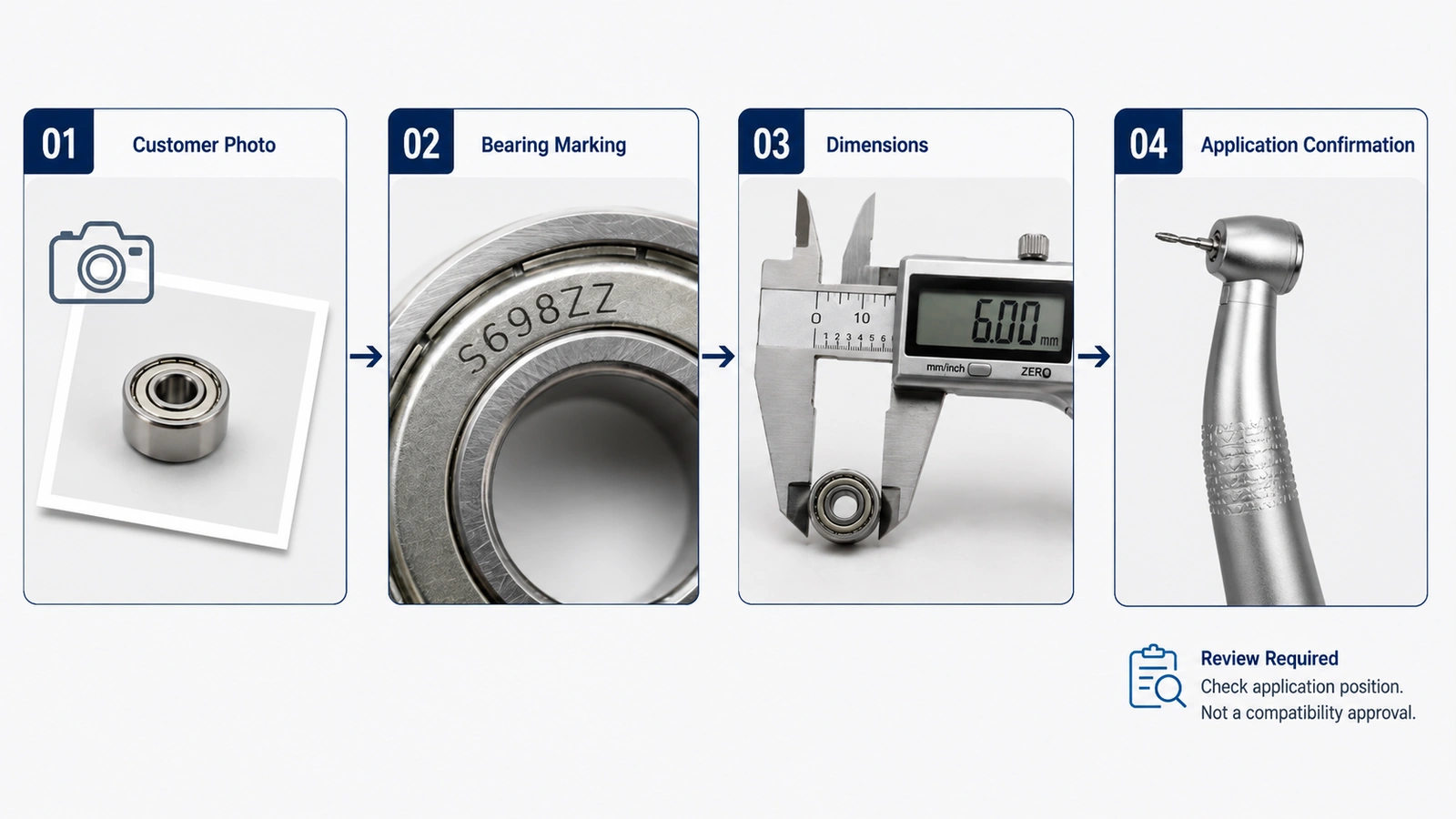
Start with the exact Sirona or Dentsply Sirona model. Record the serial or version information where available, confirm regional or connection details and the assembly or bearing position, then compare the bearing number, dimensions and available application evidence.
No. Brand compatibility is too broad. Confirm the exact model, relevant serial or version data, assembly, bearing position and individual bearing specification before ordering.
Serial or version information can help distinguish model configurations that share a name. Use serial ranges only when documentation or supplied evidence supports them.
Potentially. Different serial ranges, regional versions, connections or assemblies may require separate confirmation. A model-name match alone is not always sufficient.
No universal assumption should be made. Rolling-element material should be confirmed from the exact bearing specification for the proposed application.
Dimensions can narrow possible products, but they do not automatically confirm contact design, material, cage, shield, assembly, bearing position or handpiece compatibility.
Documents, service records and market references may use either Sirona or Dentsply Sirona. Preserve the name shown on the source and use the exact model, version and assembly for identification.
Record any visible family, serial, regional or connection information, measure the removed bearing and submit clear handpiece and bearing photos through the identification page for technical review.
Use the brand entity, exact model, serial or version information, regional or connection details, assembly, bearing position and product reference together. If any of these details are unclear, submit the handpiece or bearing for technical review before ordering.