Identify the Source Reference
Preserve the original reference, its source brand or namespace and its reference type.

Reviewed Reference Relationship Tool
Understand how dental bearing, supplier, manufacturer and historical references relate. Compare the bearing record, specifications, known differences and application status before selecting a replacement.
Definition
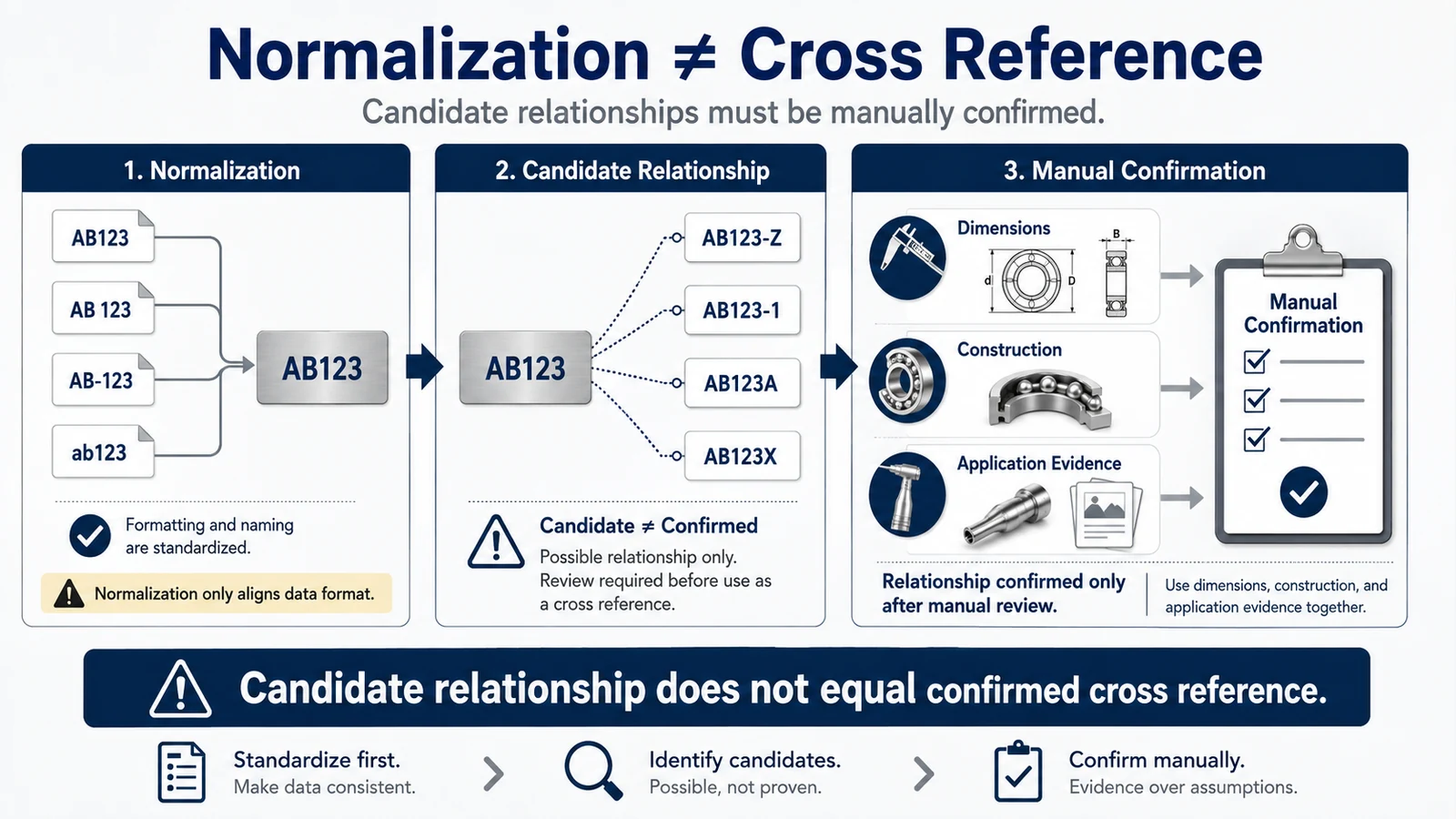
A dental bearing cross reference is a reviewed relationship between one bearing, supplier or manufacturer reference and another bearing record, product reference or replacement candidate. It should not be treated as automatic proof of complete interchangeability.
Preserve the original reference, its source brand or namespace and its reference type.
Map the source only when a real relationship record and supporting evidence exist.
Review specifications, known differences, application status and evidence before ordering.
Critical Data Rule
Handles reviewed formatting differences such as case, spacing or accepted punctuation for the same identifier.
Question: Is this the same reference written differently?
Connects different references only when a reviewed relationship exists between their source and target records.
Question: What verified relationship exists between Reference A and Record B?
Second Critical Rule
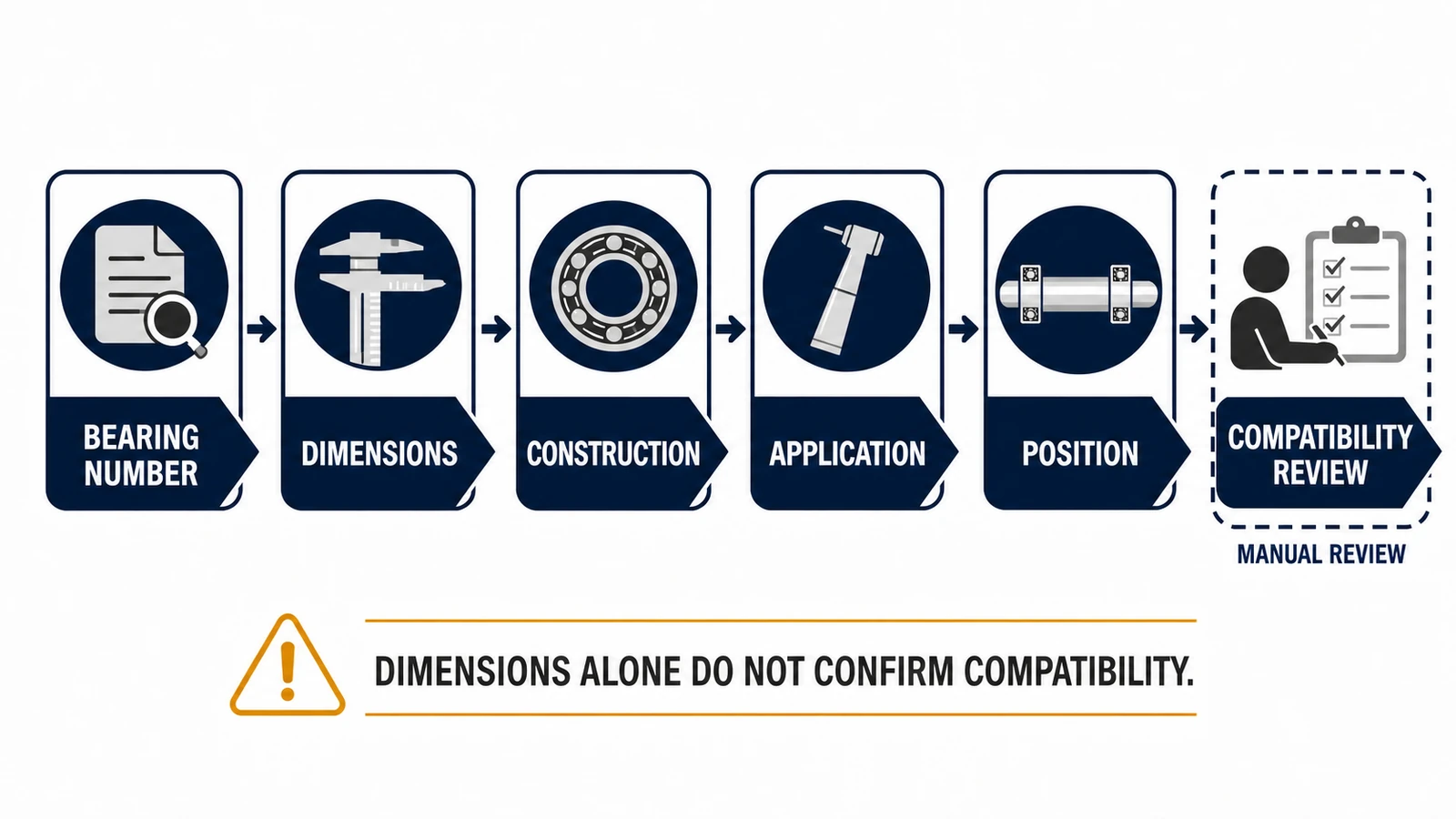
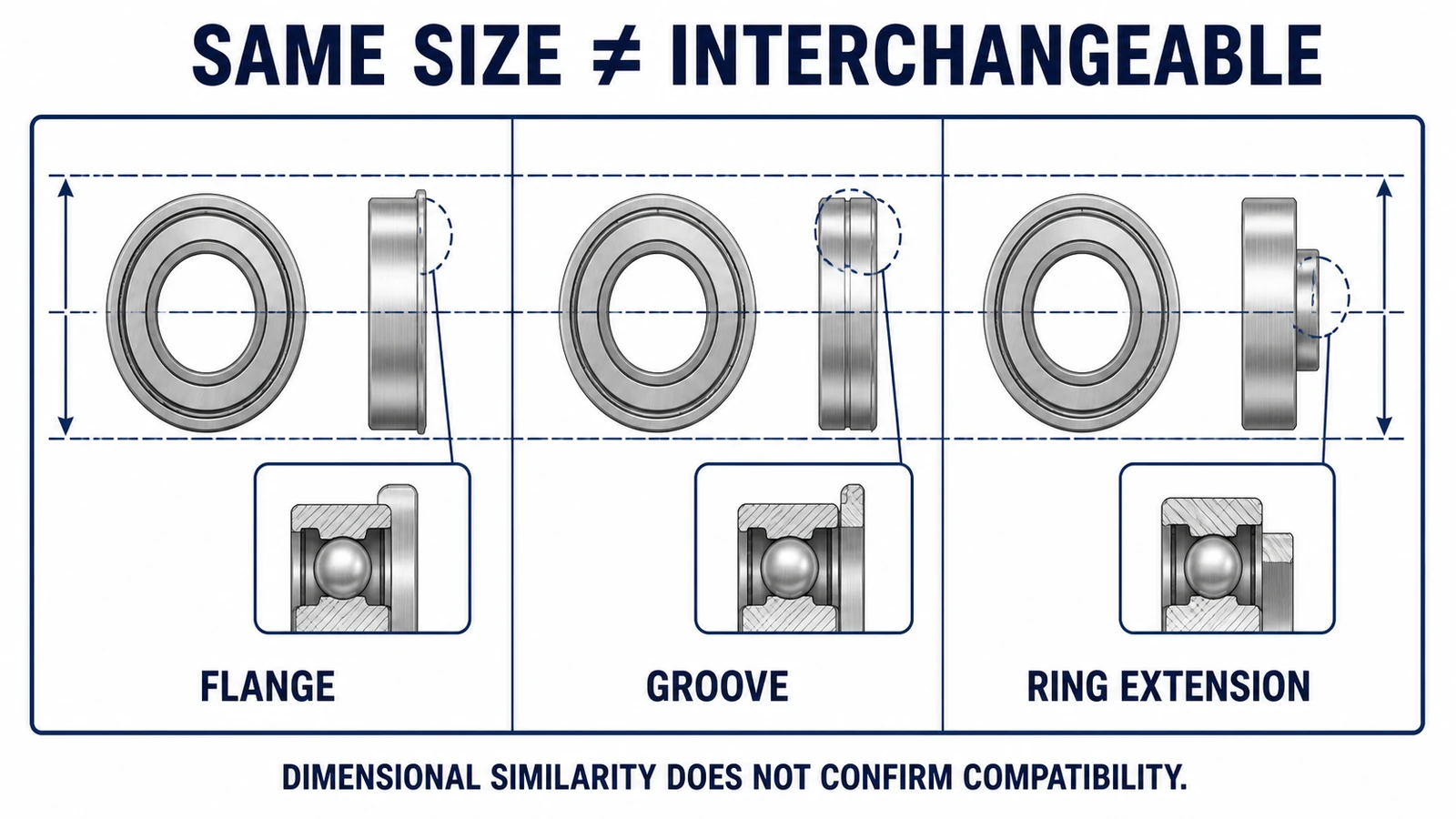
Matching ID, OD and width can identify a dimensional candidate, but a reviewed cross-reference requires a separate source-to-target relationship. Material, cage, shield, contact design, geometry and application can still differ.
Relationship Status
Avoid generic labels such as “Equivalent” or “Compatible.” The user should understand exactly what type of relationship has been reviewed.
Application Confirmation
Reference mapping and application compatibility are two separate relationships. After a cross-reference is found, review the exact handpiece, assembly, bearing position and any required version data.
Reference Relationship Status
Reviewed Cross-Reference / Historical Match / Supplier Match / Dimensional Candidate / Unresolved
Compatibility Status
Verified Application / Version Confirmation Required / Application Confirmation Required / Technical Review Required
Directional Relationships
A reviewed source reference may map to a replacement candidate without proving that the reverse relationship is an exact equivalent in every specification or application.
Store the direction that the evidence actually supports, including any difference or application notes.
Create a reverse relationship only when that relationship is separately supported or explicitly defined as bidirectional.
No Reviewed Match?
Do not stop at “No Results.” Route the user based on the type of information still available.
Use the exact identifier tool if the entered number is the bearing’s primary number rather than an alternate reference.
Use ID, OD and width to find dimensional candidates without labeling them as cross references.
Use reviewed model and application data to identify likely bearing records.
Combine partial markings, dimensions, model information and photos.
Bearing Family Routing
If a reviewed target belongs to a dedicated bearing-family page, show the family relationship here and let the family hub own the dimensions, variants and family-specific application content.
For SR144 dimensions, variants and family-specific application information, use the dedicated SR144 bearing family page.
E-E-A-T & Relationship Review
The evidence should support the relationship itself—not just the existence of the target bearing.
Preserve source brand or namespace, original reference value and reference type.
Confirm target bearing number, product record, dimensions and relevant construction fields.
Compare dimensions, material, cage, shield, contact design, geometry and documented differences.
Attach relationship status, application status and the real source supporting the mapping.
Supplier Mapping RFQ
Submit source brand, supplier references, existing descriptions, dimensions, current products and quantities for structured cross-reference and commercial review.
Quick Answers
A dental bearing cross reference is a reviewed relationship between one bearing, supplier or manufacturer reference and another bearing record, product reference or replacement candidate. It should not be treated as automatic proof of complete interchangeability.
Not necessarily. A reviewed cross-reference identifies a relationship between references. Specifications, known differences, application, bearing position and other technical details may still require comparison.
No. Equal ID, OD and width identify a dimensional candidate, not automatically a reviewed cross-reference relationship. Construction and application data may still differ.
Different manufacturers, suppliers and internal systems can use different designation namespaces. The source helps identify which reference system the entered number belongs to.
Yes. A source reference may map to a reviewed replacement candidate without proving that the reverse relationship is an exact equivalent in every specification or application.
A partial reference can narrow candidates but should not automatically be treated as a reviewed cross-reference. Add the primary bearing number, dimensions, handpiece model or clear photos where possible.
Use the primary bearing-number lookup if you have the exact number, the size chart if you have dimensions, the model lookup if you know the handpiece, or bearing identification when the available reference is incomplete.
Yes. A bulk workflow can separate reviewed cross references, application-dependent records, dimensional candidates and unresolved references before matched products are added to an RFQ.
Start with the source namespace and complete reference, review the mapped target record and known differences, then confirm the handpiece application before ordering.