Aftermarket replacement part. Independently manufactured — not supplied by or affiliated with the handpiece manufacturer.
- Fitment scope — front and rear turbine bearings, rotor cartridges, back covers and low-speed parts across the 640, 646, 636, 900 Small Head and SMARTtorque families.
- Ceramic or steel balls — silicon nitride (Si3N4) or 440C stainless in the same envelope, so the material choice never changes the fit.
- ISO P4 / ABEC-7 precision class — built for 400,000+ RPM service.
- Wholesale and repair-shop friendly — tray quantities, repeatable lot-to-lot tolerances, and named internal part numbers you can re-order against next quarter.
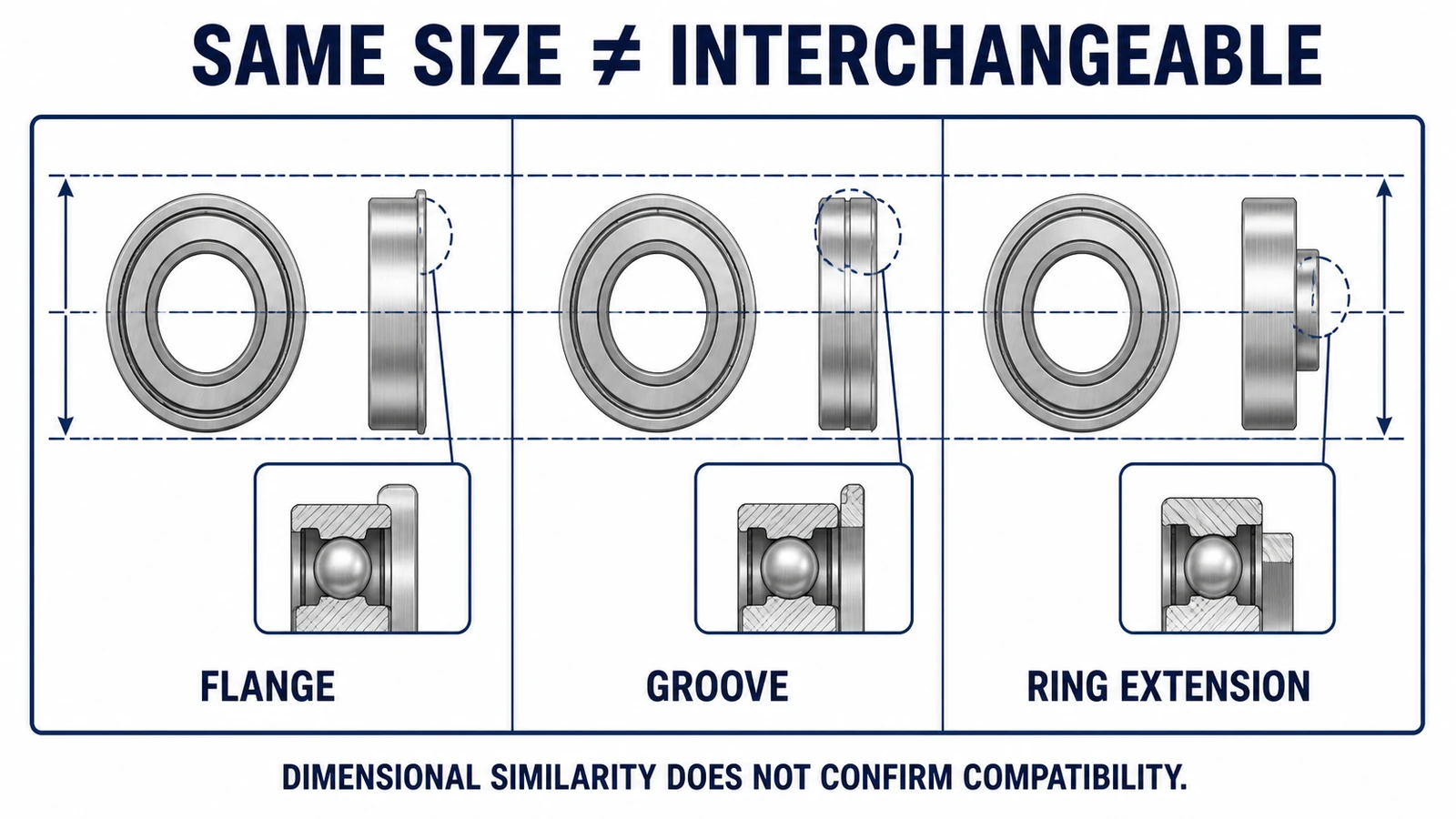
Most bearing returns we see are not quality failures. They are width failures — the right bore, the right outer diameter, the wrong 0.4 mm. Start with the table below, cross-check it against the dental bearing size chart, then confirm your head stamp before you order.
Cross-reference: bearings for KaVo turbine handpieces
All dimensions in millimetres (ID × OD × Width). Aftermarket replacement parts — independently manufactured.
| Handpiece Model | Head Type | Bearing Position | Bearing Size — ID × OD × W (mm) | Confirm your width |
|---|---|---|---|---|
| KaVo 640 B | Standard Head | Front (chuck side) | 3.175 × 6.35 × 2.38 or 2.78 mm (confirm suffix) | Send a photo — free, 1 hr |
| KaVo 640 B | Standard Head | Rear (cap side) | 3.175 × 6.35 × 2.38 or 2.78 mm (confirm suffix) | Send a photo — free, 1 hr |
| KaVo 640 C | Standard Head | Front (chuck side) | 3.175 × 6.35 × 2.38 or 2.78 mm (confirm suffix) | Send a photo — free, 1 hr |
| KaVo 646 B / 646 C | Standard Head | Front (chuck side) | 3.175 × 6.35 × 2.38 or 2.78 mm (confirm suffix) | Send a photo — free, 1 hr |
| KaVo 646 B / 646 C | Standard Head | Rear (cap side) | 3.175 × 6.35 × 2.38 or 2.78 mm (confirm suffix) | Send a photo — free, 1 hr |
| KaVo 636 / 636 C | Standard Head | Front (chuck side) | 3.175 × 6.35 × 2.38 or 2.78 mm (confirm suffix) | Send a photo — free, 1 hr |
| KaVo 900 Small Head | Small Head | Front (chuck side) | 3.175 × 6.35 × 2.38 or 2.78 mm (confirm suffix) | Send a photo — free, 1 hr |
| KaVo 900 Small Head | Small Head | Rear (cap side) | 3.175 × 6.35 × 2.38 or 2.78 mm (confirm suffix) | Send a photo — free, 1 hr |
| SMARTtorque S605 C Mini | Mini Head | Front (chuck side) | 3.175 × 6.35 × 2.38 or 2.78 mm (confirm suffix) | Send a photo — free, 1 hr |
Front and rear bearings differ on many models. Confirm both before ordering.
Model not listed above? You can also search bearings by handpiece model — or send a photo and we will match it against the head stamp for you.
What size bearing does a KaVo 640 use? The 640 head carries two bearings, not one: a front unit on the chuck side and a rear unit under the back cap. They share a bore and outer diameter but not always a width, and the B and C variants are not automatically identical. Exact figures are pending engineering sign-off.
Why KaVo dental bearings wear out — and what fails first
The chuck-side bearing almost always goes first. It sits closest to the bur, so it absorbs the lateral load every time you lean into a crown prep, and it takes the brunt of the water, debris and disinfectant that migrate into the head.
Failure is rarely dramatic. It starts as a change in pitch — a thin whine instead of a smooth hiss. Then comes measurable runout at the bur tip, which shows up in your margins before it shows up in your ears. Torque drops next, because energy that should reach the bur is being spent as heat and vibration inside the head.
Three mechanisms drive most of it. Autoclave cycling dries and embrittles the cage. Lubricant washout leaves the balls skidding rather than rolling for the first fraction of a second at spin-up. And micro-pitting on the raceway, once started, accelerates fast at 400,000 RPM.
The practical signal for repair shops: if the bur wobbles under light finger pressure with the handpiece off, the bearing set is finished. Replace both positions together. Our notes on handpiece noise, vibration and runout troubleshooting cover the earlier warning signs, before the wobble is visible.
Which KaVo models we cover
KaVo 640 B / 640 C
The large-head SUPERtorque workhorse — high wattage, heavy cutting, and a turbine that repair shops rebuild constantly. Front and rear bearings must be replaced as a pair here; swapping only the noisy one leaves an unbalanced set that will fail again within weeks. We supply both positions in ceramic or steel.
KaVo 646 B / 646 C
The SMARTtorque 646 uses a fixed-connection body and a four-port spray head, and it is one of the most widely serviced entry-tier German turbines in circulation. Bearings are the standard consumable. Confirm whether your unit is the lit B or the unlit C variant before ordering — the head assembly differs in detail.
KaVo 636 / 636 C
The COMPACTtorque 636 family runs a Borden two-hole or Midwest four-hole fixed connection and appears in 636, 636 P, 636 C and 636 CP forms depending on chuck type. Older units in daily service often have never had a bearing change. Push-button variants need the chuck mechanism checked at the same time.
KaVo 900 Small Head
Small-head geometry means a narrower bearing seat and less room for error. Width is the variable that catches people out — a standard-head bearing will physically enter the bore but will not sit correctly. If your head is stamped as a small-head unit, tell us before you order and send the stamp.
SMARTtorque S619 / S609 C / S605 C Mini
The SMARTtorque series splits into standard-head (h ≈ 14.5 mm) and mini-head (h ≈ 12.3 mm) versions, and the two do not share a bearing set. We carry rotor cartridges and impellers for both. Mini heads are the most frequently mis-ordered part in this whole range.
We also stock more than loose bearings
For KaVo-pattern heads we hold complete rotor cartridges XK-01 (S619C) and XK-05 (S605C), the impeller S609C, and back covers H-17, H-18/S605, H-19, S609 and H-32. On the low-speed side — INTRAmatic-pattern contra-angles and straight handpieces — we stock ZW-K1 through ZW-K5, plus ZW-K8 and ZW-K9 (S201L). That is fifteen re-orderable line items, which matters when you are stocking a bench rather than fixing one handpiece. If you would rather not source positions separately, our pre-matched turbine bearing kits pair front and rear in a single order. Ask for the current wholesale tiers.
A note on ceramic ball options
Silicon nitride balls weigh roughly 60% less than steel, so centrifugal load on the outer race drops sharply at full speed and the head runs cooler and quieter. Ceramic is a material choice, not a fitment change — the envelope is identical, so it drops into the same seat. Full comparison, including where steel is still the sensible buy, lives on our ceramic dental bearings page.
Sterilization, cage material and service life
Autoclaving is what kills most turbine bearings, not cutting. A 134 °C cycle drives moisture into the head, strips whatever oil film survived the last run, and thermally cycles a cage that was never designed to be boiled twice a day.
Our high-speed bearings use a Torlon (polyimide) cage, chosen because it holds dimensional stability through repeat cycles better than phenolic. Rings are 440C-grade stainless. Autoclave compatibility is rated to 134 °C.
The lubrication protocol matters more than the brand of oil. Purge and lubricate before sterilization, not after — oil applied to a hot, dry bearing after the cycle sits on the surface instead of reaching the raceway. Run the handpiece briefly after lubricating to distribute the film and expel excess.
On service life: our own bench testing gives 1,000 hours+ under continuous load at 2.5 kg air pressure, and 500 hours+ in dry, no-oil testing. We do not publish a lifespan multiplier for ceramic over steel, because we have not measured one under controlled conditions and neither, as far as we can tell, has anyone else selling these parts. Manufacture is to ISO P4 / ABEC-7, tested to GB/T 30701-2005, under an ISO 9001 quality system.
Not sure which bearing fits? Don’t guess. Send us a photo of your turbine or your old bearing — our technicians identify the correct size and part number within 1 business hour.
Include the head-size stamp if visible — width varies by head.
Start here: send photos for free bearing identification — no account needed, no obligation to buy.
FAQ
What size bearing does a KaVo 640 use?
The 640 takes a front and a rear bearing in the standard-head envelope. Bore and outer diameter are shared across the pair; width is not always. We publish exact figures only after engineering sign-off. Send a photo and we will match it against the head stamp.
Are the front and rear bearings the same on KaVo turbines?
Often not. Many heads pair a wider chuck-side bearing with a narrower cap-side one. Ordering two of the same part is the single most common mistake we correct. Always confirm both positions.
Can I fit ceramic balls to a 636 head?
Yes. Ceramic changes the ball material, not the outside dimensions, so a hybrid bearing drops into the same seat as the steel version. It is worth doing on heads that see heavy daily use and frequent sterilization.
How long should replacement bearings last in a 900 Small Head?
Our bench figure is 1,000 hours+ under continuous testing at 2.5 kg air pressure. Real chairside life depends far more on lubrication discipline and autoclave frequency than on the bearing itself. Shops that purge before every cycle see roughly double the life of shops that do not.
Do you supply rotor cartridges as well as loose bearings?
Yes. Complete rotors XK-01 (S619C) and XK-05 (S605C), impeller S609C, and back covers H-17, H-18/S605, H-19, S609 and H-32 are stocked. Repair shops usually mix both: cartridges for fast turnaround, loose bearings for margin.
“`html
“`
Related pages
- dental turbine bearings — the full high-speed category
- bearing cross-reference lookup — search by handpiece or part number
- SR144 bearing specifications — why one part number describes two widths
- ceramic dental bearings — Si3N4 versus steel, in detail
All brand names are trademarks of their respective owners, used solely to identify compatible applications. Products are independently manufactured and not OEM parts.
Product Gallery